The New European Competitiveness Test: Can the EU Stop Wasting Its Own Resources?
As the EU prepares its forthcoming Circular Economy Act, circularity is moving from the margins of environmental policy to the centre of Europe’s competitiveness agenda. This article argues that waste is no longer merely a disposal problem, but a strategic test of Europe’s industrial resilience, resource security and ability to build a functioning market for secondary raw materials. With plastics at the heart of the debate, the piece explores why Europe must transform recycling, product design, traceability and material reuse into pillars of a stronger, greener and more self-reliant economy.
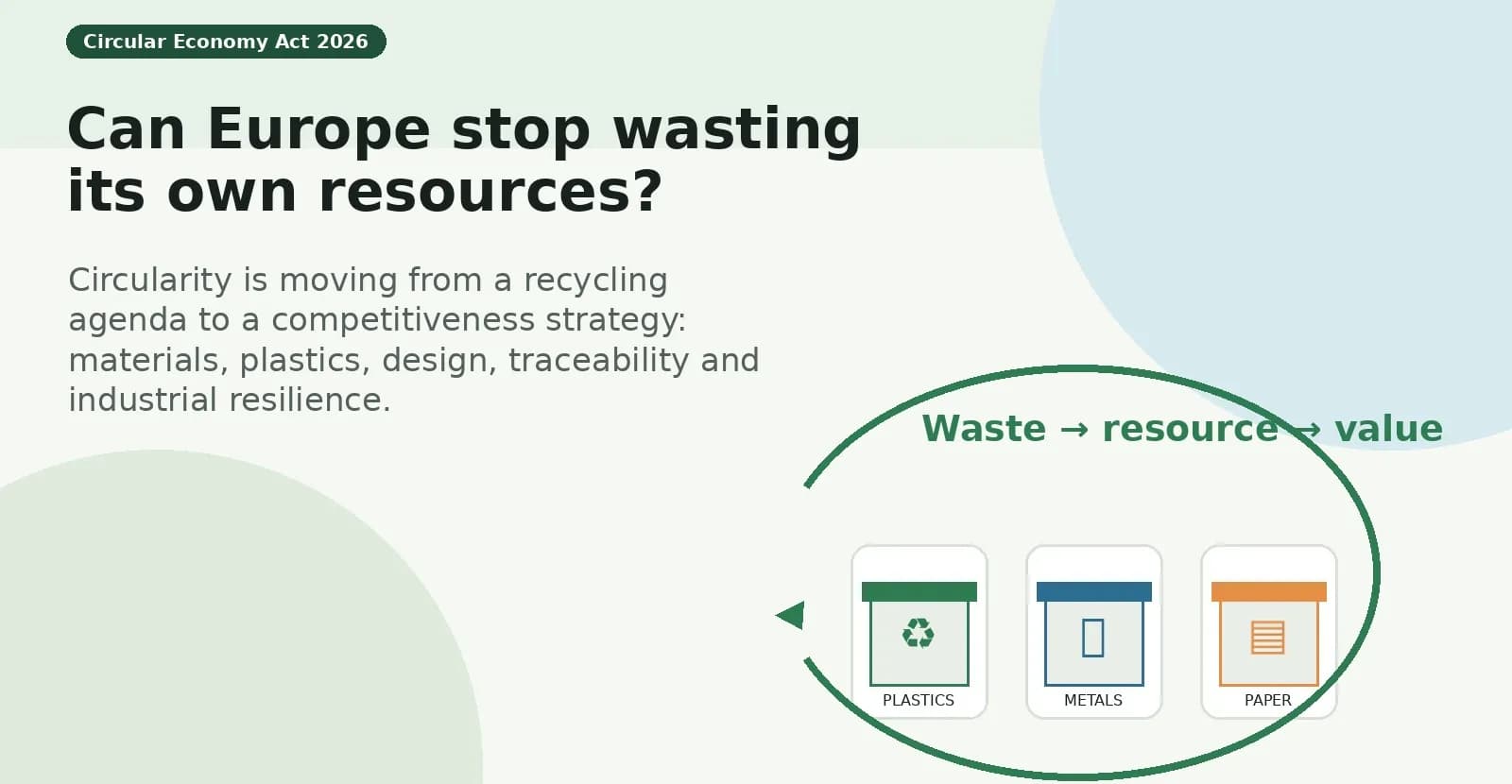
The Circular Economy Act, plastics and the future of Europe’s industrial resilience
For a long time, the circular economy sounded like a polite environmental ambition. It belonged to the language of sustainability conferences, recycling campaigns and corporate responsibility reports. It was important, but often treated as separate from the harder questions of industry, competitiveness and economic security.
That era is ending.
The forthcoming EU Circular Economy Act marks a shift in how Europe understands circularity. It is no longer only about reducing waste or encouraging citizens to recycle more carefully. It is about whether Europe can build an economy that keeps valuable materials in circulation, reduces dependence on imported resources and strengthens its industrial base at a time of global competition.
This is why the debate around the Circular Economy Act matters. It comes at a moment when Europe is trying to answer a difficult question: how can it remain competitive while becoming greener, more secure and less vulnerable to external shocks?
The answer may lie partly in something Europe has too often treated as an afterthought: waste.
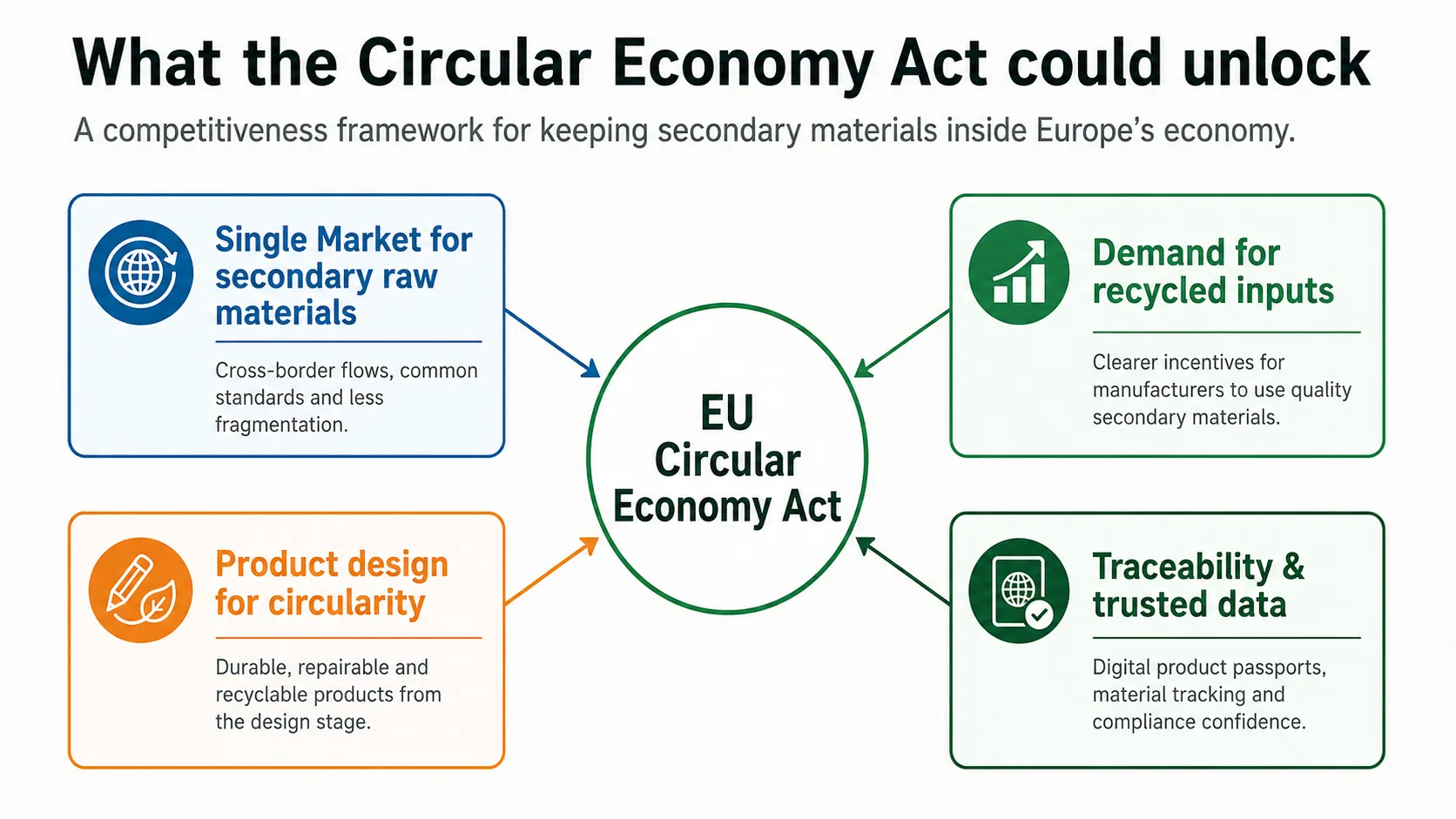
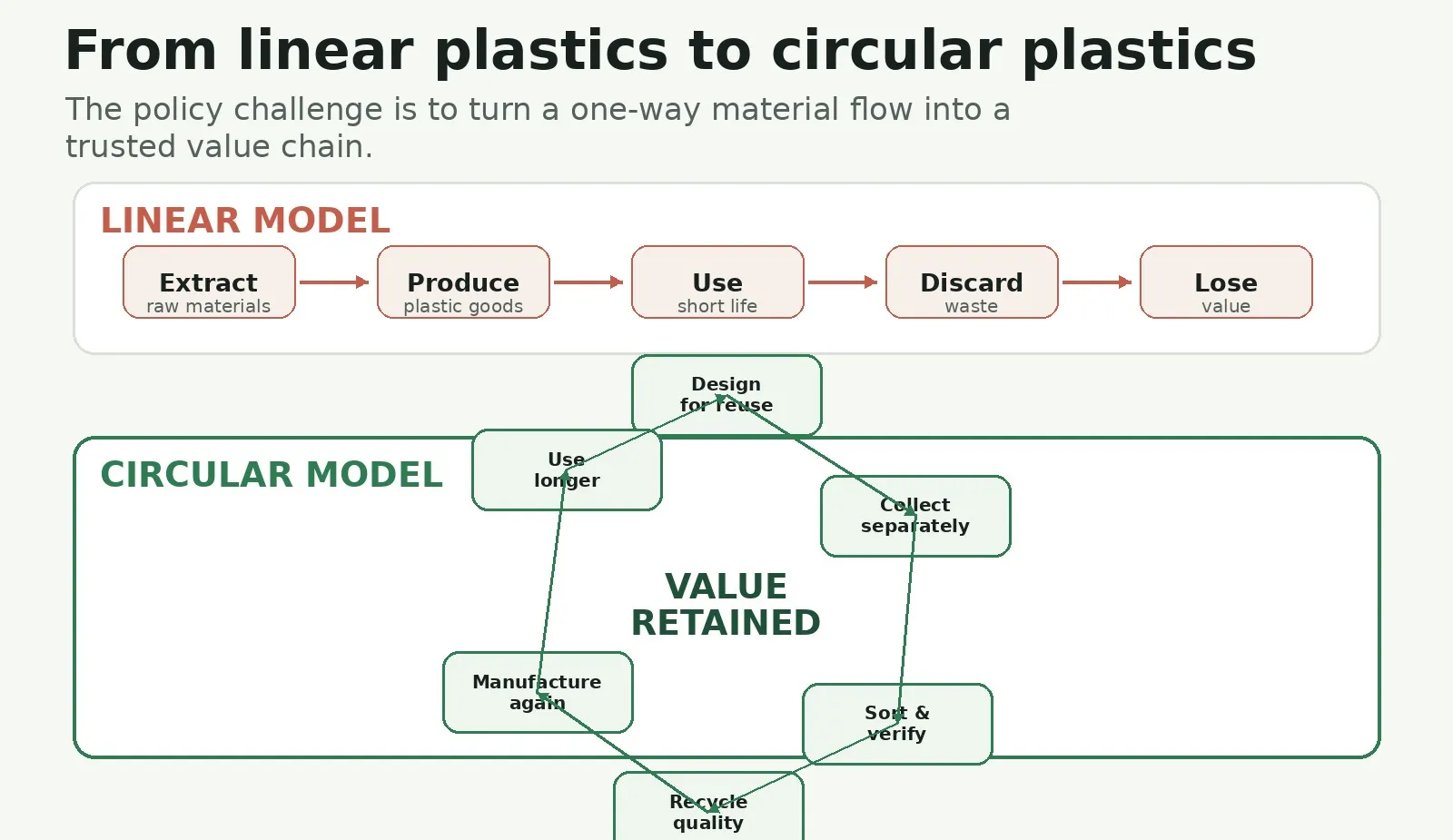
In the old linear economy, materials move in one direction. They are extracted, transformed into products, consumed and discarded. This model created growth, convenience and industrial scale. But it also created dependency, pollution and enormous material losses. In a world of cheap energy, stable supply chains and abundant raw materials, those losses were easier to ignore. In today’s world, they look increasingly irrational.
Europe imports many of the resources it needs for its economy. It faces high energy costs, geopolitical uncertainty, climate obligations and strong competition from the United States, China and other industrial powers. At the same time, huge quantities of materials still leave the European economy as waste, are downcycled, incinerated, landfilled or exported. That is not only an environmental failure. It is a strategic weakness.
The circular economy offers a different logic. Instead of asking only how to produce more, it asks how to preserve more value from what has already been produced. Instead of treating used materials as a burden, it treats them as industrial assets. Instead of measuring competitiveness only by output, it also measures it by resilience, efficiency and control over material flows.
Plastics show this challenge especially clearly.
Plastic is one of the most important materials in the modern economy. It is used in packaging, construction, transport, medicine, agriculture, electronics and renewable-energy technologies. Its advantages are obvious: it is light, versatile, durable and relatively inexpensive. But those same qualities also make plastic one of the most visible symbols of the linear economy. Too much of it is still designed for short use, difficult to recycle, or lost from the productive cycle.
The problem is not simply that Europe uses plastic. The problem is that Europe has not yet built a fully functioning circular plastics economy.
A circular plastics economy would mean that products are designed with reuse and recycling in mind from the beginning. It would mean that plastic waste is collected separately, sorted efficiently, processed into high-quality recycled materials and used again by manufacturers. It would mean that recycled plastics can compete fairly with virgin materials, that consumers can trust recycling systems, and that companies can rely on stable supplies of secondary raw materials.
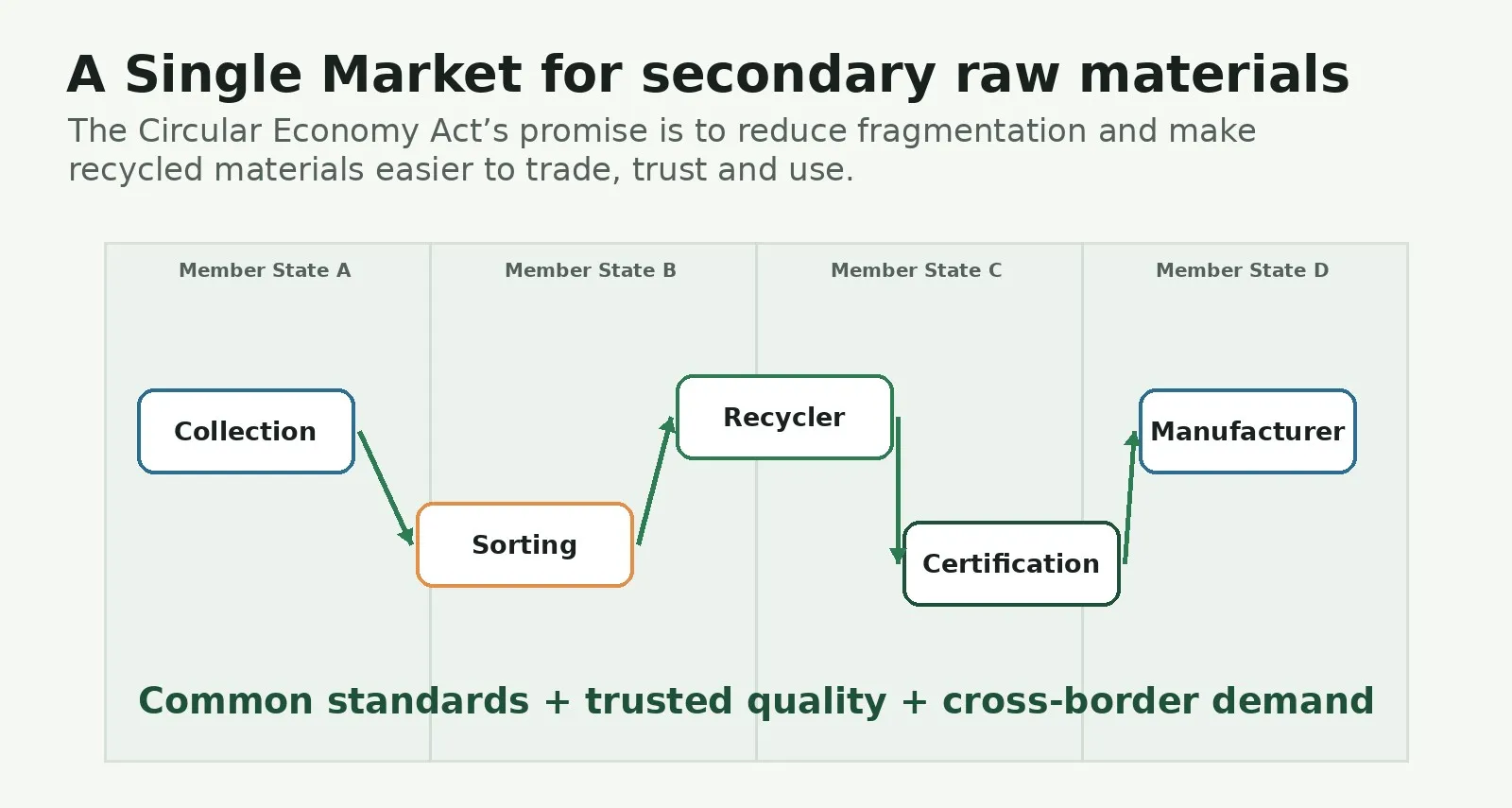
This is where the Circular Economy Act could become important. If designed well, it could help move Europe from fragmented recycling efforts toward a real Single Market for secondary raw materials. That would be a major step. Today, the circular economy is often slowed down by inconsistent rules, uneven infrastructure, uncertain quality standards and weak demand for recycled inputs. A bottle, a food tray, a car part or an electronic device may contain valuable material, but without the right system that value is easily lost.
The challenge is not only technical. It is economic.
Recycling does not succeed simply because it is environmentally desirable. It succeeds when the economics work. Recyclers need predictable demand. Manufacturers need reliable quality. Investors need regulatory certainty. Consumers need convenient systems. Public authorities need transparent data. Without these conditions, circularity remains vulnerable to price fluctuations, cheap imports, poor sorting and low trust.
This is particularly true for plastics. European recyclers face strong pressure from high operating costs and global competition. If recycled materials are more expensive than virgin alternatives, or if imported materials enter the market without credible verification, the circular transition becomes fragile. Companies may support circularity in principle but hesitate in practice. Investment may slow. Recycling capacity may struggle. Public confidence may decline.
That is why Europe’s circular economy strategy must be more than a waste policy. It must be an industrial policy.
This means creating demand for recycled materials, not only collecting waste. It means setting clear rules for product design, recycled content, traceability and quality. It means investing in sorting and recycling technologies. It means supporting innovation in mechanical recycling, chemical recycling where appropriate, reuse systems and alternative business models. It also means ensuring that circular products and materials can move efficiently across the European market.
The Packaging and Packaging Waste Regulation already points in this direction by pushing packaging toward recyclability, reduced use of virgin materials and increased use of recycled plastics. But the Circular Economy Act can go further by addressing the broader material economy, not just one product category. It can help Europe think about resources as part of competitiveness, not only as part of environmental compliance.
This shift is essential because the next phase of the green transition will be material-intensive. Renewable energy, electric mobility, digital infrastructure, construction renovation and clean technologies all require enormous quantities of materials. Europe cannot build a resilient green economy while continuing to waste valuable resources at the end of product life. Decarbonisation and circularity must therefore be seen as connected projects.
Circularity can also create jobs and business opportunities. Repair, refurbishment, remanufacturing, recycling, reverse logistics, reuse platforms, eco-design, digital traceability and secondary-material marketplaces can all become growth sectors. The circular economy is not only about doing less harm. It is about building new forms of value creation.
Yet Europe must avoid presenting circularity as if it were effortless. The transition will require investment, coordination and political discipline. It will also require a realistic approach to businesses, especially small and medium-sized enterprises. If circular economy rules are too complex, too expensive or too bureaucratic, they may create resistance instead of transformation. But if companies receive clear standards, accessible funding, shared infrastructure and simple digital tools, circularity can become a competitiveness advantage.
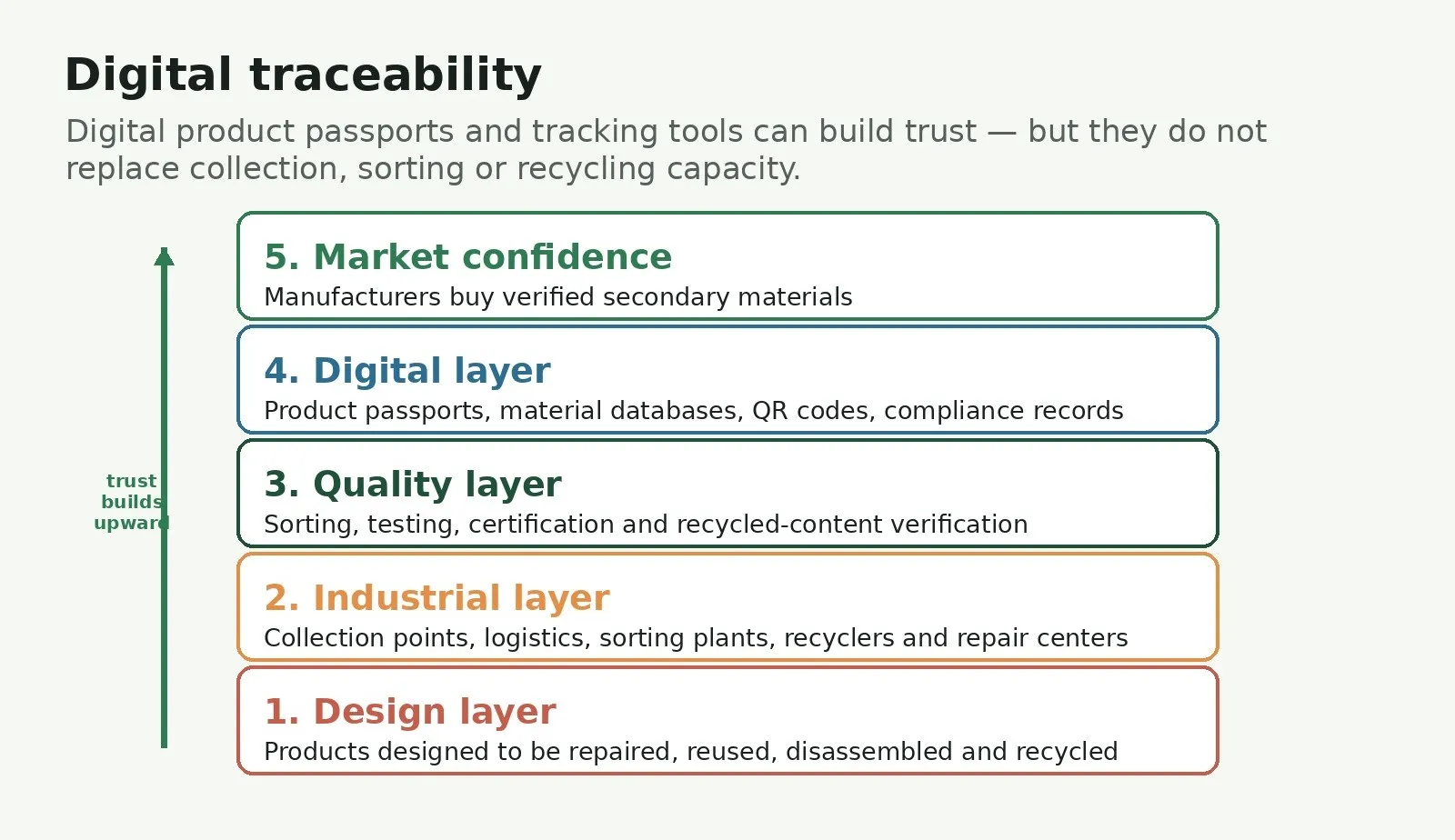
Digitalisation will be central to this process. A circular economy depends on information: what a product contains, where materials come from, how they can be repaired, whether they can be recycled, and where they go after use. Digital product passports, traceability systems and material databases can help make circular markets more transparent. They can also reduce fraud, support compliance and build trust between producers, recyclers, regulators and consumers.
But digital tools are not magic. A QR code cannot replace a recycling plant. A digital product passport cannot compensate for poor product design. A blockchain platform cannot sort waste. Technology can strengthen the circular economy only when it is connected to real infrastructure, credible standards and functioning markets.
The deeper question is cultural as much as economic. Europe has to stop seeing waste as the end of a product’s life and start seeing it as the beginning of another cycle. That requires a change in design, regulation, business strategy and consumer behavior. It also requires a change in political imagination. The circular economy should not be described as a sacrifice. It should be understood as a smarter way to organize prosperity.
The Circular Economy Act therefore arrives at a decisive moment. Europe wants to be greener, but also stronger. It wants to reduce emissions, but also preserve industry. It wants open markets, but also greater security. Circularity sits at the intersection of all these ambitions.
The future of European competitiveness may not depend only on new mines, new factories or new trade agreements. It may also depend on whether Europe can recover the value already circulating inside its own economy.
A discarded plastic package, an old phone, a used battery, a demolished building component or a broken appliance may look like waste. In a circular economy, each is also a test: of design, infrastructure, markets and political will.
The real question is no longer whether the circular economy is good for Europe.
The real question is whether Europe can afford to keep wasting its own resources.
Hudayberdi Kochumov
Contributing writer at EUReflect.
Follow EUReflect
See more of our reporting on Google
Mark EUReflect as a preferred source and our stories are ranked higher for you in Top Stories, Discover and Google News — and carry a “preferred” badge when they are cited in AI results.
Add EUReflect as a preferred source