The Next Global Powers
India's 6.4% growth forecast and strategic autonomy position it as the top candidate to join the US and China at the highest level of global power.
The international system is entering a period in which the definition of a “superpower” is becoming more complicated.
Military strength and nuclear weapons remain important, but economic scale, population, technological capacity, energy security, critical minerals, industrial production, diplomatic networks and control over supply chains increasingly determine how much influence a country can exercise.
In 2026, the global economy itself is reinforcing this shift. The IMF expects world growth of around 3 percent this year, but growth is increasingly uneven and tilted toward countries integrated into technology, manufacturing and expanding consumer markets.
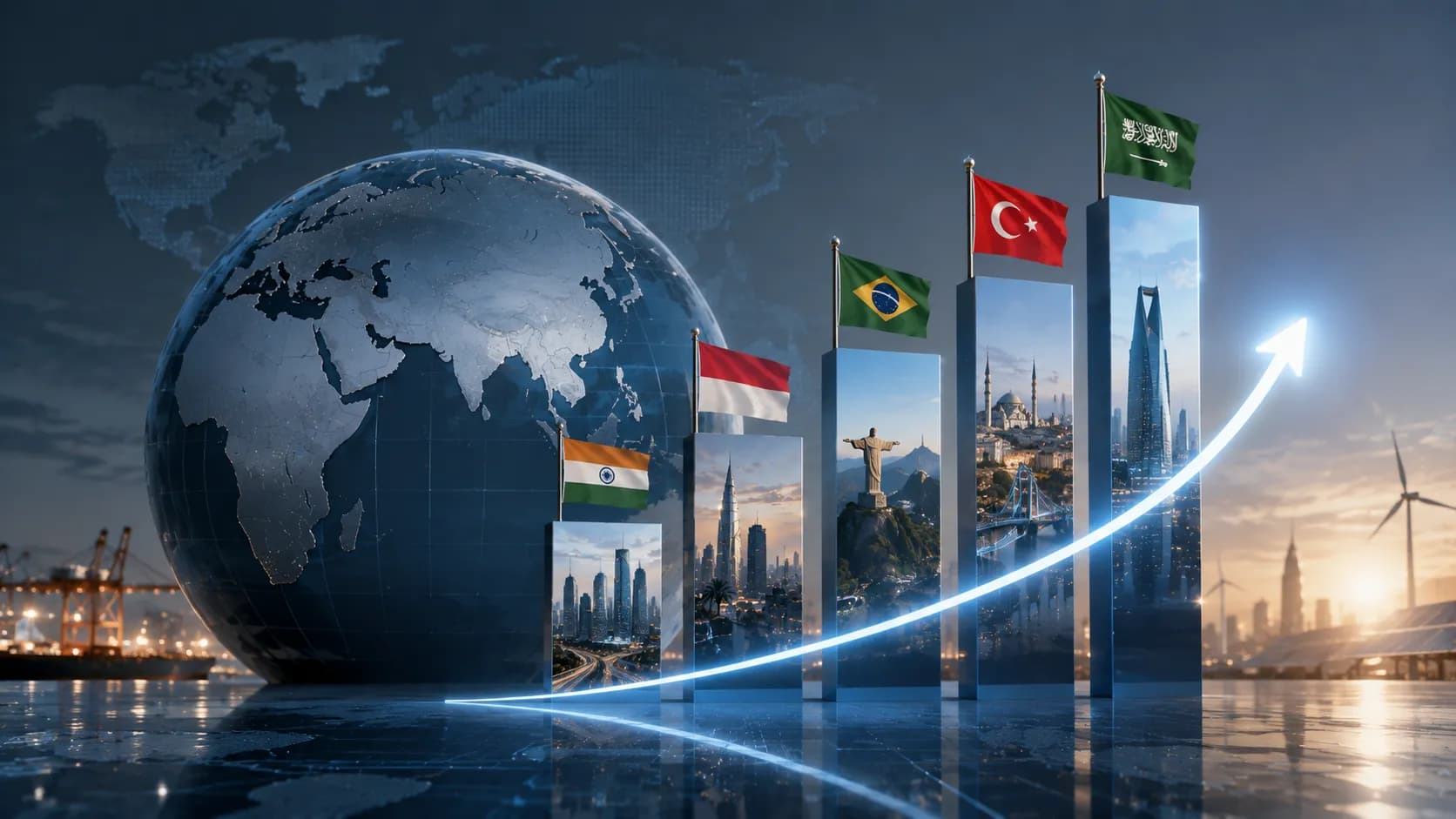
Among today's developing and emerging economies, India has the clearest path toward superpower status, while Indonesia and Brazil possess strong long-term potential. Türkiye and Saudi Arabia represent a somewhat different category: their populations and economic scale make eventual global superpower status less certain, but their strategic influence is expanding much faster than their economic size alone would suggest.
India Is the Strongest Candidate
India stands apart from the other candidates because it combines almost every component required for global power.
Its population is approaching 1.5 billion, it possesses nuclear weapons, maintains one of the world's largest militaries, has an established space program and benefits from a large technology and services sector.
The economic trajectory is particularly important.
The IMF currently projects Indian growth of 6.4 percent in 2026, keeping it among the fastest-growing major economies. A Reuters survey published this week was even more optimistic about the latest quarter, estimating April-June growth at around 7.1 percent.
India also possesses something that many emerging economies lack: strategic autonomy.
New Delhi cooperates with the United States through Indo-Pacific structures while remaining in BRICS, maintaining relations with Russia and developing partnerships across the Middle East, Africa and Europe.
India therefore does not need to become part of another superpower's bloc.
It is increasingly capable of becoming a pole of its own.
Its main obstacles remain infrastructure gaps, income inequality, employment creation and the challenge of transforming rapid economic growth into substantially higher productivity.
But among developing countries, India is currently the strongest candidate to eventually join the United States and China at the highest level of global power.
Indonesia Has the Best Long-Term Surprise Potential
Indonesia receives less attention, but its structural advantages are significant.
It has more than 280 million people, occupies a strategic position between the Indian and Pacific oceans and controls access to some of the world's most important maritime trade routes.
It is also a G20 economy worth approximately $1.4 trillion and possesses major reserves of nickel, copper, tin, gold and bauxite.
Nickel is particularly important because Indonesia has attempted to stop functioning merely as a raw-material exporter.
Jakarta has encouraged domestic processing and investment in battery and electric-vehicle supply chains, seeking to convert geological resources into industrial capacity.
Its geopolitical position is equally interesting.
Indonesia maintains a traditionally non-aligned foreign policy and is attempting to develop relations with both China and the United States. This week, Jakarta and Beijing agreed to deepen cooperation in defense, artificial intelligence, minerals, energy and technology, including plans involving defense production and technology transfer.
If Indonesia successfully combines industrialization, resources, demographic scale and maritime geography, it could become one of the major powers of the Indo-Pacific.
Its greatest challenge is technological depth. To reach the highest level, Indonesia must move from mineral processing and manufacturing toward advanced technology, research and globally competitive companies.
Brazil Has Resources Few Countries Can Match
Brazil represents perhaps the strongest potential global power in Latin America.
Its advantages begin with scale.
Brazil possesses a continental-sized territory, more than 200 million people, enormous agricultural production, freshwater resources, energy potential and significant mineral reserves.
Critical minerals are making Brazil even more strategically important.
The country possesses the world's second-largest rare-earth reserves, attracting growing interest from American, Australian, Canadian and other international investors as governments seek alternatives to Chinese-controlled supply chains.
Brazil also possesses diplomatic advantages.
It is a member of the G20 and BRICS and has long sought a stronger voice for developing countries in international institutions. Brazil and South Africa this week again emphasized reform of the global financial architecture and greater Global South influence.
But Brazil's challenge is converting potential into sustained power.
The IMF describes the economy as resilient but identifies high public debt and weak productivity growth as important structural problems.
Brazil already possesses the territory, resources and population of a major power.
What it still needs is sustained industrial and technological growth.
Türkiye Is Becoming a Strategic Power
Türkiye follows a different path.
With approximately 86 million people, it is unlikely to match India or Indonesia in demographic scale. Its economic challenges are also substantial: the IMF currently projects 2026 growth of 2.9 percent and consumer-price inflation of 28.6 percent.
But Türkiye possesses unusually high geopolitical influence relative to its economic size.
Its location connects Europe, the Black Sea, Caucasus, Middle East, Mediterranean and Central Asia. It controls the Turkish Straits, maintains NATO's second-largest military and has developed an increasingly sophisticated domestic defense industry.
Its diplomatic reach also extends across competing political blocs.
A major example arrived this month.
Türkiye, Saudi Arabia and Pakistan signed the Mecca Joint Defense Agreement on August 7, establishing a collective-defense framework and plans for deeper military, political and defense-industrial coordination.
This illustrates Türkiye's potential trajectory.
It may not become a conventional superpower comparable to the United States or China. But it could become one of the most influential cross-regional powers, capable of affecting several strategic regions simultaneously.
Saudi Arabia Is Turning Capital Into Influence
Saudi Arabia represents another unconventional candidate.
Its population is far smaller than India's, Indonesia's or Brazil's, which limits its long-term ability to become a traditional global superpower.
But Riyadh possesses three extraordinary assets: energy, capital and geography.
Saudi Arabia remains central to global oil markets while using Vision 2030 to expand into logistics, technology, tourism, manufacturing, mining and defense.
Its strategy increasingly involves transforming financial wealth into geopolitical networks.
The new defense agreement with Türkiye and Pakistan demonstrates this evolution. Saudi Arabia brings financial and energy power, Pakistan contributes nuclear and military weight, and Türkiye provides significant conventional and defense-industrial capabilities.
Riyadh is simultaneously maintaining relationships with Washington while expanding cooperation with China, India and other Asian economies.
Saudi Arabia's future power will therefore depend heavily on whether it can successfully diversify before the global energy system becomes significantly less dependent on oil.
The Real Race Is Between India, Indonesia and Brazil
If “superpower” is defined strictly as the ability to project economic, technological, military and diplomatic power globally, the candidates are not equal.
India is already approaching the threshold of global great-power status and has by far the strongest superpower potential.
Indonesia has the strongest long-term combination of population, strategic geography, minerals and industrialization after India.
Brazil possesses exceptional resources and continental scale but needs stronger productivity and technological development.
Türkiye and Saudi Arabia are different. They may become extremely influential strategic powers without possessing the demographic and economic scale traditionally associated with a full global superpower.
Other emerging economies — including Vietnam, Nigeria, Mexico and eventually several African states — also deserve attention, but currently lack one or more of the economic, institutional, technological or military pillars necessary to compete at the highest level.
The most important conclusion is that the next superpower may not emerge by copying the United States or China.
The international system is becoming multipolar enough to allow countries to build power differently.
India can build it through population, technology and military capability.
Indonesia through resources, manufacturing and maritime geography.
Brazil through food, energy, minerals and continental scale.
Türkiye through defense technology and strategic geography.
Saudi Arabia through capital, energy and geopolitical partnerships.
The global power hierarchy of 2040 may therefore look very different from today's.
The question is no longer whether emerging countries will gain influence. It is which of them can transform economic potential into technological, military and institutional power before their demographic and geopolitical opportunities begin to close.
Ahmet Balakan
Contributing writer at EUReflect.
Follow EUReflect
See more of our reporting on Google
Mark EUReflect as a preferred source and our stories are ranked higher for you in Top Stories, Discover and Google News — and carry a “preferred” badge when they are cited in AI results.
Add EUReflect as a preferred source