Uzbekistan Financial Transformation and Investment Report
Uzbekistan is transforming its “double landlocked” disadvantage into an advantage through multi-directional logistics corridors, green energy, digitalization, and investor-friendly reforms. Its 2030 vision aims to position the country as Eurasia’s new trade and investment hub, driven by strong growth, legal security, low costs, and broad regional access.

1. Introduction: Reversing Geographic Destiny
Located in the heart of Turkistan, Uzbekistan is one of only two countries in the world, along with Liechtenstein, with "double landlocked" status. This status means the necessity of crossing at least two neighboring countries' borders to access the open seas. In the pre-2016 period, this geographic constraint led to extra logistical costs ranging between 20% and 50% in the country's foreign trade, causing economic isolation and a fragile structure dependent on a single corridor.
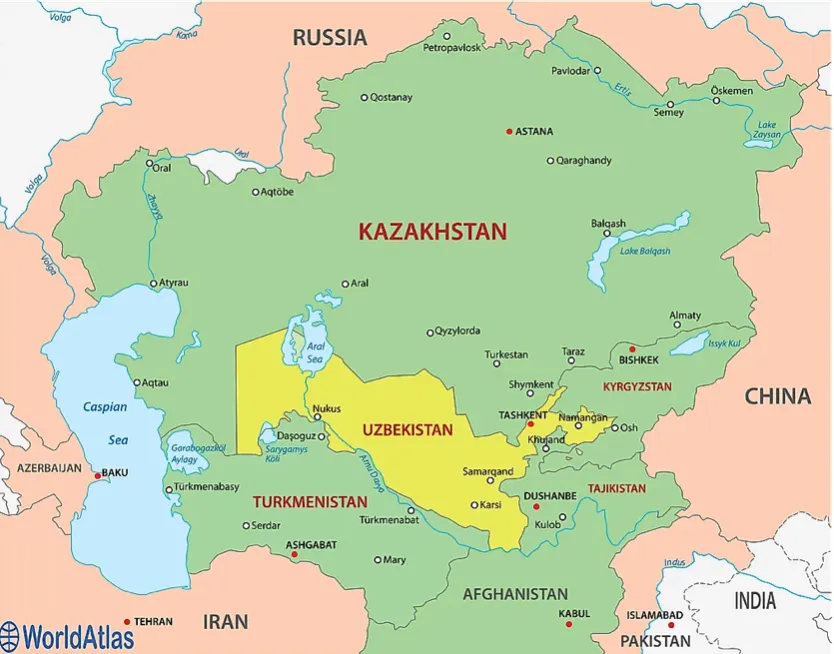
However, global and regional developments over the past decade have enabled Uzbekistan to transform this historical disadvantage into a strategic advantage. The Tashkent administration has repositioned the country from being a passive transit zone to an active trade hub that connects markets as "land-linked." The disruption of traditional routes in the north due to wars and sanctions has dramatically increased the importance of southern and western corridors.
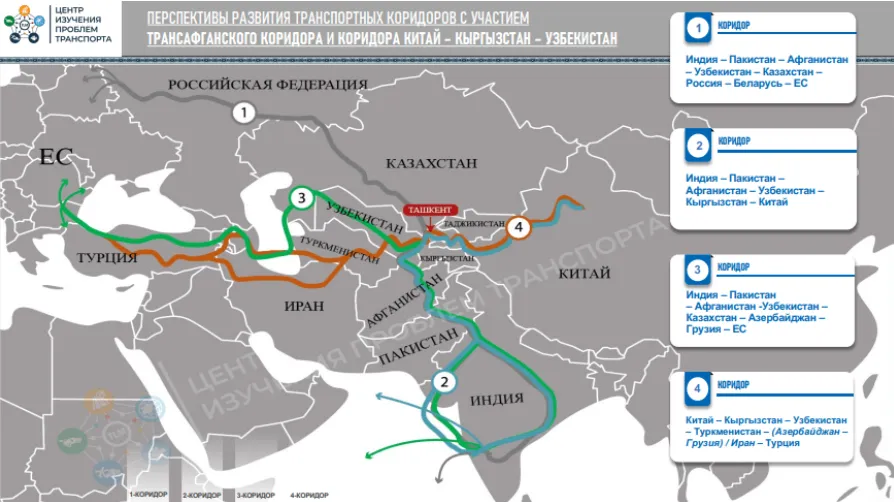
2. Multi-Directional Corridor Strategy: The Backbone of Logistical Transformation
2.1. East-West Axis: Safe Passage from China to Europe
The fundamental pillar of Uzbekistan's logistical transformation consists of two critical projects positioned on the East-West axis:
China-Kyrgyzstan-Uzbekistan (CKU) Railway: When this line is completed, shipments from China to Uzbekistan are expected to be significantly shortened in terms of distance and time, and the Central Asia internal connection of the Middle Corridor is expected to be strengthened.
Trans-Caspian International Transport Route (Middle Corridor): The "Trump Peace and Prosperity Route" (TRIPP) agreement signed on August 8, 2025, with US mediation, is the most concrete example of this geopolitical move. With the agreement, the corridor connecting Armenia, Azerbaijan, and Nakhchivan was leased to the US for 99 years, minimizing geopolitical risks in the region and creating a safe, sanction-free route connecting Uzbekistan to Europe via the Caspian Sea.
2.2. Southern Axis: The Shortest Route to Open Seas
Trans-Afghan Railway Project offers Uzbekistan the shortest access alternative to open seas via Pakistani ports. With the completion of the project, exporters' access time to Pakistani ports will decrease from 35 days to 3-5 days, reducing shipping costs by one-third and significantly increasing their global competitiveness.
Additionally, the route extending to Iran's Bandar Abbas and Chabahar ports via Turkmenistan is a complementary route already used in the country's foreign trade.
2.3. Infrastructure Modernization and Performance Leap
Infrastructure investments in railways, highways, and logistics centers aimed at supporting international corridors have begun to yield concrete results. While Uzbekistan ranked 123rd among 150 countries in the World Bank Logistics Performance Index (LPI) in 2007, it has now risen to 88th place thanks to modernized customs regimes, digitalized border crossings, and investments in transportation infrastructure.
The aviation sector is also an important part of this transformation. As of 2024, 11 airports have reached 13.5 million passengers and 14,400 tons of cargo volume. The new cargo terminal in Tashkent and the renovation of Urgench Airport through the Public-Private Partnership (PPP) model are bringing the country closer to becoming a regional "Aviation Hub."
Multimodal Logistics Centers constitute 37% of the total warehouse capacity of 970,000 square meters and maximize supply chain efficiency by bringing customs clearance and value-added services under one roof.
3. Vision 2030: Comprehensive Economic Transformation Strategy
Uzbekistan's "Uzbekistan-2030" strategy is a comprehensive roadmap aimed at transforming the country from a state-led structure to a free market economy, from a raw material exporter position to a global industrial and technology center. This vision includes not only economic growth but also a multi-dimensional reform package targeting the transition to green energy, digitalization, development of human capital, and full integration into international trade nodes.
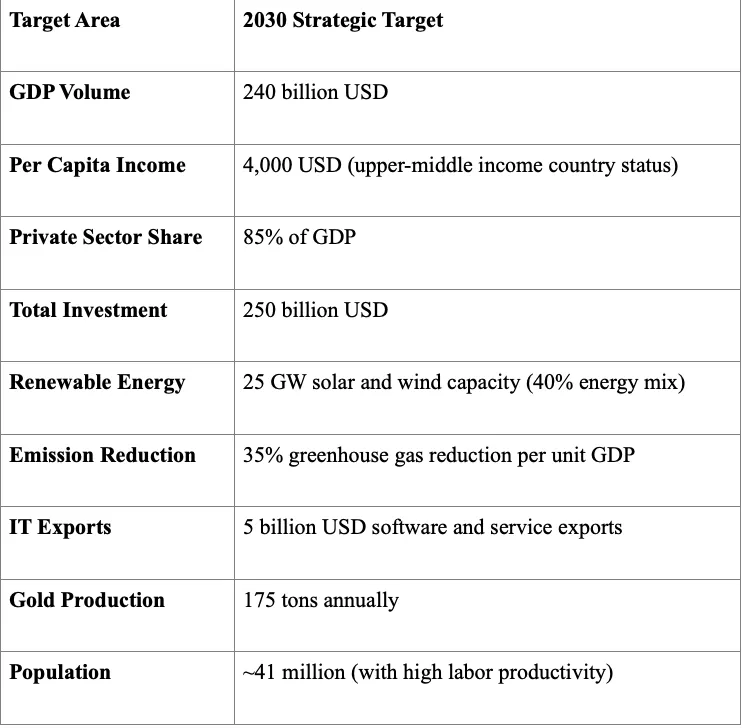
3.1. Main Economic Targets
3.2. Industrial Policy: Transition from State to Private Sector
At the center of economic transformation is the radical reduction of the state's role in the economy and the strengthening of the private sector. In this process, privatization of state enterprises and the expansion of public-private partnership (PPP) projects play a critical role.
The industrial policy focuses on abandoning raw material exports and concentrating on the production of high value-added products. Increasing deep processing capacities in copper, gold, uranium, and textile sectors has been prioritized. Increasing copper cathode production and raising gold production to 175 tons annually are concrete indicators of this strategy.
3.3. Green Energy Revolution and Sustainable Infrastructure
With the declaration of 2025 as the "Year of Environmental Protection and Green Economy," logistical infrastructure has begun to be supported by clean energy. Uzbekistan aims to reduce dependence on fossil fuels in electricity generation, increase the share of renewable energy sources above 40%, and commission a total of 25 GW capacity solar and wind energy facilities.
The Guzar Project is the strongest example of this vision. The project, carried out by UAE-based Masdar and supported by the Asian Development Bank's (ADB) $9 million partial credit guarantee, has 300MW solar energy and 75MWh battery storage capacity. Through Battery Energy Storage Systems (BESS), the intermittent nature of renewable energy is balanced, thus providing "grid-ready" and reliable clean energy for heavy industry and logistics centers. This structure guarantees the energy security of logistics operations at ESG (Environmental, Social, and Governance) standards.
Energy efficiency is planned to be increased by 20% across industry, and greenhouse gas emissions per unit GDP are planned to be reduced by 35% compared to 2010 levels.
3.4. Digitalization: The Digital Backbone of the Economy
Within the framework of the "Digital Uzbekistan 2030" strategy, IT services and software exports are targeted to reach $5 billion. The integration of artificial intelligence and big data technologies into public services is concretized through the consolidation of more than 130 public databases and more than 350 online services under the "E-Government" platform.
4. Macroeconomic Performance and Investment Environment
4.1. Strong Growth Trend and Stability
The Uzbekistan economy exceeded expectations with a strong growth performance of 7.6% in the first nine months of 2025. The International Monetary Fund (IMF) has revised the country's growth forecasts upward, projecting expansion at 6.8% and 6% levels for 2025 and 2026, respectively.
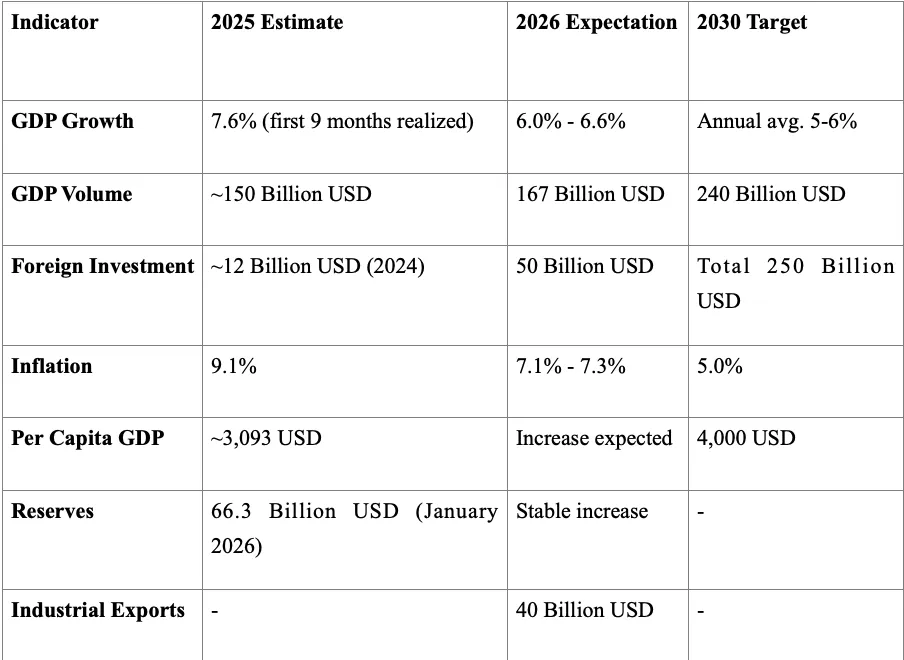
While inflation is expected to rise to 9.1% in 2025, the Central Bank and government aim to bring this rate to the 5-7% band in the medium term. The country's gold and foreign exchange reserves, which serve as a buffer against external shocks, reached $66.3 billion as of January 1, 2026, supporting macroeconomic stability.
4.2. Investment Boom and Credit Rating Upgrades
The government is pursuing an aggressive investment attraction strategy. While $50 billion in foreign investment is targeted for 2026 alone, recently signed investment agreements total $140 billion. In 2026, 782 new industrial and infrastructure projects worth a total of $52 billion are planned to be launched.
International credit rating agencies have responded positively to the country's reform efforts:
Fitch Ratings: Raised credit rating to BB- level
S&P Global: Revised outlook to "Positive"
4.3. Deepening of the Financial System
Significant steps have been taken within the framework of the strategy to reduce the state's share in the banking sector:
Privatizations: The acquisition of Ipoteka Bank by Hungary-based OTP Bank for $324 million has been an important milestone in the transparency of the financial system. The government plans to privatize other major state banks such as AsakaBank, SQB, and AloqaBank in the 2025-2026 period.
Capital Market Development: Bond issuances (Eurobonds) of giant state-owned enterprises such as Navoi Mining and Uzbekneftegaz have been successfully carried out in international markets. Global fund managers such as Franklin Templeton have been included in the management of the National Investment Fund.
International Financing Partnerships: Organizations such as ADB, AIIB, and EBRD not only provide capital through projects such as the Karshi-Shakhrisabz-Kitab highway rehabilitation and Bukhara railway electrification but also carry out critical technical expertise transfer on modern customs standards and digital logistics management.
4.4. WTO Membership and Foreign Trade Reforms
In line with the goal of full membership in the World Trade Organization (WTO) by 2026, state monopolies are being eliminated and customs tariffs are being harmonized with international standards. This structural transformation aims to transform Uzbekistan from a raw material exporter position to an industrial center that produces high value-added products and is integrated into global supply chains.
5. Strategic Incentives for Foreign Investors
Uzbekistan has created a comprehensive incentive package to attract global capital. This package not only provides financial advantages but also includes systemic reforms that provide legal security and operational convenience.
5.1. Golden Visa Program
The "Golden Visa" program, which came into effect on June 1, 2025, offers foreign investors a fast and secure entry point:
Basic Conditions:
Minimum investment of 250,000 USD (company establishment, real estate, or strategic projects)
5-year residence permit with "fast-track" principle
Easily renewable permit when investment continuity is ensured
Family Unity: Residence rights are also granted for the investor's spouse, children, and parents. An additional contribution of 150,000 USD is required for each family member. These funds are directly directed to profitability-oriented companies, prestigious real estate projects, or the state's strategic national projects.
5.2. Enterprise Uzbekistan: British Law Guarantee
The "Enterprise Uzbekistan" International Digital Technologies Center, established within IT Park in November 2025, is managed according to British Law (England & Wales) principles to maximize investor confidence:
Transactions are conducted entirely by English-speaking expert staff
Possible disputes are resolved by independent courts with international standards
The risk of legal uncertainty is eliminated
This structure makes Uzbekistan the safest operation center in the region.
5.3. Single Window Revolution
One of the most critical reforms in improving the investment environment is the administrative simplification moves that reduce state pressure on the business world:
More than 500 unnecessary regulatory and supervisory functions have been completely eliminated
More than 130 public databases and more than 350 online services have been consolidated under the "E-Government" umbrella
All processes from company establishment to licensing can be managed transparently from a single center
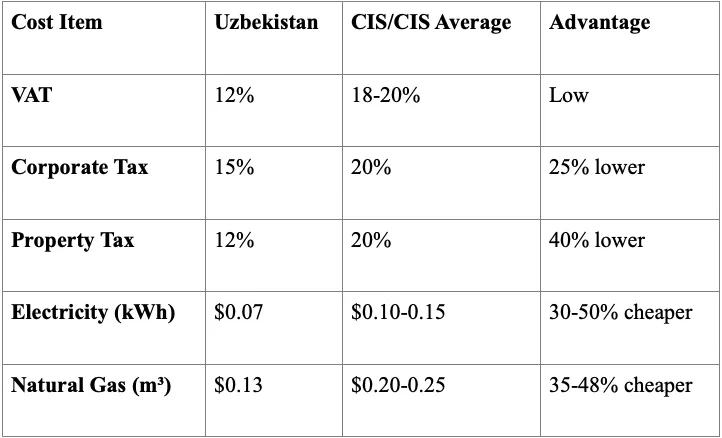
5.4. Cost Advantages: The Region's Competition Paradise
In addition to structural reforms, Uzbekistan stands out with the most competitive cost table in the region:
Sectoral Special Incentives:
Businesses deriving 90% of agricultural income: 0% Corporate Tax
Renewable energy projects: Uninterrupted and clean energy guarantee with Masdar and ADB financing
Logistics companies: Access to Pakistani ports in 3-5 days via Trans-Afghan railway (reduced from 35 days)
6. Strategic Assessment: Why Now, Why Uzbekistan?
The Uzbekistan market offers a rare "window of opportunity" for foreign investors as of 2026. This window stems not only from the country's double-digit growth potential but also from the minimization of structural risks.
6.1. Three Fundamental Strategic Advantages
1. Demographic Dividend
The fact that 60% of the population is under 30 makes Uzbekistan not just a cheap labor pool but also a rapidly growing consumer market hungry for digital services, education, and healthcare. This means a vibrant domestic market of 37 million for retail, fintech, and service sector investors.
2. The End of Legal Arbitrage
The adoption of British Law through structures such as "Enterprise Uzbekistan" has eliminated the risk of "legal unpredictability," the biggest obstacle in emerging markets. The investor now operates in Tashkent under a legal protection umbrella at London standards.
3. Regional Access Gateway
Investment in Uzbekistan is not limited to the local market. Thanks to TRIPP and Trans-Afghan corridors, the country is a customs-free and logistically optimized gateway to the Central Asian population of over 80 million and South Asian markets.
6.2. Timing Factor: Early Entry Advantage
The "timing" factor, which is critical for investors, is currently working in favor of Uzbekistan. The country is in an "early mover" phase where state assets are being privatized, the market is being liberalized, but has not yet reached saturation. Investors entering during this period will:
Obtain higher market shares with lower entry costs
Play an active role in shaping the regulatory framework
Be in a priority position in local partnerships and privatization processes
Benefit from the "first mover" advantage as the market grows
7. New Economic Hub
Uzbekistan is transforming the historical disadvantages of being "double landlocked" into a global trade center that is "land-linked" through a rational geopolitical strategy and comprehensive economic reforms. This transformation rises on three fundamental dynamics:
1. Logistics Revolution: The 35-rank rise in the logistics performance index, multi-directional corridor strategy, and infrastructure modernization based on green energy make Uzbekistan the indispensable logistics center of Eurasia.
2. Financial Integration: The harmonization of the financial system with international standards, privatizations, and the inclusion of global fund managers position the country as a reliable investment destination.
3. Investor-Friendly Ecosystem: Golden Visa, Enterprise Uzbekistan, and competitive cost structure make Uzbekistan not only a production base but also a regional management and innovation center.
In a period when traditional trade routes are shaken by geopolitical crises, the triangle of "stability, low cost, and legal security" offered by Uzbekistan constitutes a strong response to the search for a safe harbor for global capital. Every step taken in line with the 2030 vision nominates the country to become the indispensable heart of Eurasia's new Silk Road.
Joining this strategic transformation story now means assuming a decisive role in the future Eurasian economy.
8. Sectoral Investment Opportunities and Strategic Recommendations
The structural reforms and incentive packages offered by Uzbekistan create a wide sectoral spectrum offering differentiated risk-return profiles for investors. Below, the advantages, opportunity areas, and strategic assessments of each sector are detailed.
8.1. Priority Investment Sectors
A. Energy and Green Technology (Highest Incentive, Strategic Priority)
The energy sector is the area where Uzbekistan provides the most aggressive incentives and strategic prioritization. Facilities producing high-tech renewable energy equipment benefit from zero profit tax advantage for three years after becoming operational. The country's 2030 target is to supply forty percent of electricity from renewable sources and reach a total installed power capacity of 25 GW. Billion-dollar projects by global energy giants such as Masdar and ACWA Power create a wide market for both the supply chain and subcontractors in this sector.
Growth rate in solar and wind energy is particularly remarkable, and opportunity areas not yet saturated exist. Additionally, Battery Energy Storage Systems (BESS), which are critical for grid stability, stand out as an unsaturated area. The 75MWh capacity storage system implemented in the Guzar project is a concrete example of this area. Furthermore, energy efficiency technologies aimed at the twenty percent efficiency increase target for industrial facilities also constitute an important niche market. The risk profile of the sector is quite low; projects are government-guaranteed and receive support from international financing institutions such as ADB and AIIB.
B. Textile and Apparel (Radical Tax Reform)
The textile sector is one of the most concrete areas of Uzbekistan's transition from raw material exporter status to finished product exporter identity. As of September 2025, valid for three years, the social tax rate for textile enterprises and clusters has been reduced from twelve percent to one percent. This radical tax reduction is a clear indicator of state support for the sector. Additionally, customs duty exemption has been introduced for the import of mixed fabric and leather industry raw materials. The country has a raw material advantage due to being the world's sixth largest cotton producer, and the government aims to double textile exports in 2026.
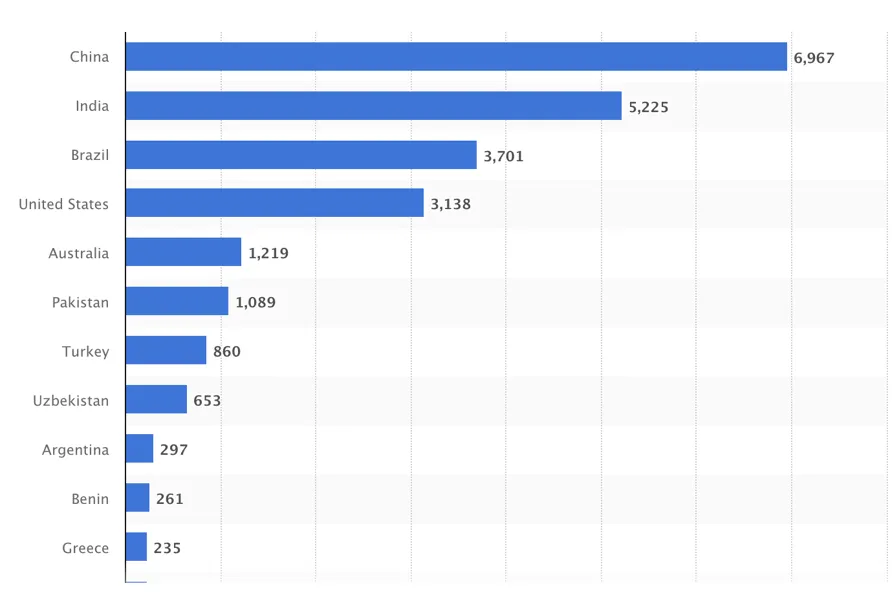
Opportunity areas are concentrated particularly in value-added segments such as ready-to-wear and knitwear production instead of raw yarn, fabric dyeing and printing facilities. Additionally, technical textile production for automotive, construction, and healthcare sectors is evaluated as a high-potential area. The sector's risk profile is medium; global competition is intense, but Uzbekistan's cost advantage is quite strong and significantly increases competitiveness.
C. Information Technology (IT) and Digital Finance (British Law Guarantee)
The information technology sector is the fundamental pillar of Uzbekistan's vision to become Central Asia's digital center and is in a unique position in terms of offering British law guarantee to investors. Companies operating within IT Park pay zero corporate tax, zero VAT, and zero social tax until 2028. Personal income tax is only seven and a half percent. The Enterprise Uzbekistan International Digital Technologies Center, established in November 2025, offers a special legal regime based on British law, creating a familiar and secure ground for foreign investors.
The Regulatory Sandbox, which came into effect in January 2026, provides a flexible testing environment for investment platforms and tokenized assets in the fintech field. The country's target of reaching five billion dollars in IT services exports clearly reveals the sector's growth potential. There is regional center potential in software development and business process outsourcing (BPO), and due to low banking penetration, great opportunities exist in fintech and digital banking. Pilot projects can be developed within the Regulatory Sandbox in crypto assets and tokenization, while the growing domestic market of 37 million population also offers a favorable environment for e-commerce infrastructure investments. The sector's risk profile is low-medium; legal guarantee is strong, but the need for local human resource development should be taken into account.
D. Mining and Metallurgy (Value-Added Production Requirement)
The mining sector is at the center of Uzbekistan's strategy to transform rich natural resources into value-added products. The government plans to launch three billion dollars worth of new mining projects in 2026. Particularly investments in processing copper, gold, and uranium receive state guarantee and infrastructure support. The 2.7 billion dollar copper cathode facility implemented at the Almalyk Mining Complex is a concrete example of this support. The country's 2030 target is to increase annual gold production to 175 tons.
Copper processing and cathode production is a rapidly growing area dependent on global electric vehicle demand, while rare earth elements are critical for the technology sector. Additionally, chemistry industry areas such as fertilizer and polymer production to support agriculture also offer important opportunities. The sector's risk profile is medium; commodity price fluctuations and high initial capital requirements should be considered, but long-term cash flow potential is strong.
E. Pharmaceutical and Healthcare (Import Substitution Opportunity)
The pharmaceutical and healthcare sector offers a tremendous import substitution opportunity due to the market being ninety-eight percent dependent on imports. Companies investing in special zones such as Tashkent Pharma Park benefit from tax holidays (corporate tax, property tax, land tax exemption) ranging from three to ten years. The growing domestic market of thirty-seven million population and the potential to become an export center to the Central Asian region increase the sector's attractiveness.
There is high demand and low competition in generic drug production. State-supported biotechnology research and development centers are attractive for innovation-oriented investors. Medical device production within the hospital modernization program also stands out as an important opportunity area. The sector's risk profile is medium; regulatory processes and compliance with quality standards are required, but the market size and state support balance these risks.
8.2. Supporting Factors and Facilitators
What makes Uzbekistan's investment environment attractive is not only sectoral incentives but also structural reforms and facilitating mechanisms. The Golden Visa program, effective from June 1, 2025, grants five-year residence permits to foreigners investing 250,000 dollars and greatly facilitates the investor's entry-exit and operational processes. One of the most striking features of this program is the inclusion of family members; an additional contribution of 150,000 dollars is required for each family member, and these funds are directly directed to profitability-oriented companies, prestigious real estate projects, or the state's strategic national projects.
The bureaucracy revolution also plays a critical role in improving the investment environment. As of January 1, 2026, business registration, bank account opening, and VAT transactions can be completed in fifteen minutes through a single digital platform. More than five hundred unnecessary regulatory and supervisory functions have been completely eliminated, more than one hundred thirty public databases and more than three hundred fifty online services have been consolidated under the E-Government umbrella. This single window system allows investors to save time and costs.
Macroeconomic stability also constitutes a guarantee element for investors. International credit rating agencies such as Fitch Ratings and S&P Global have raised Uzbekistan's rating or turned the outlook to positive. The country's foreign exchange reserves have reached 66.3 billion dollars, and seven and a half percent GDP growth has been realized in the first nine months of 2025. Significant developments are also occurring in logistics; thanks to the Trans-Afghan railway project, access time to Pakistani ports is decreasing from thirty-five days to three to five days, the TRIPP corridor provides safe access to Europe, and a thirty to forty percent decrease in logistics costs is expected overall.
8.3. Strategic Investment Recommendations
The strategic approach to be considered when investing in Uzbekistan should balance both sectoral opportunities and the investor's risk appetite and time horizon. Different strategies should be implemented in line with investors' profiles and goals.
Sector selection according to the risk-appetite matrix enables investors to identify areas suitable for their own risk tolerance. Conservative investors should turn to energy and green technology with low risk profile and IT and digital finance sectors; these sectors are government-guaranteed, receive international financing support, and offer British law guarantee. For investors with balanced risk appetite, textile and apparel and pharmaceutical and healthcare sectors are suitable; in these areas, there is strong cost advantage, growing domestic and regional market, and significant tax incentives. Aggressive investors can evaluate opportunities in mining and metallurgy and regulatory sandbox opportunities in fintech; these sectors offer high capital gain potential and early entry advantage, but also bring risks such as commodity price fluctuations.
Time horizon-based approach is also a decisive factor in investment decisions. When evaluated from a short-term investment perspective of one to three years, the IT and software outsourcing field provides rapid return with low capital requirements. Ready-to-wear production in the textile sector enables rapid market penetration thanks to three-year tax incentives. E-commerce infrastructure investments can reach profitability in a short time by benefiting from the growing digital consumer base. Medium-term investments, in a three to seven-year timeframe, provide predictable cash flow through fixed purchase guarantee contracts (PPA) in solar and wind energy projects. In pharmaceutical production, import substitution and regional export potential mature in this timeframe. Logistics and warehousing investments will also reach their full potential with the completion of the Trans-Afghan railway. Long-term investments, when considered from a perspective exceeding seven years, show that the mining and metallurgy sector offers long-lived and stable cash flow despite high initial investment. Biotechnology research and development projects create value in the long term with technology transfer and patent-based returns. Public-private partnership projects in infrastructure are supported by long-term state guarantees.
In terms of entry strategies, investors can choose from four basic models. The local partnership model (joint venture) offers local knowledge, network, and bureaucracy management advantages and is recommended especially for mining, healthcare, and textile sectors; however, partner selection is critical and legal agreements need to be prepared in detail. The wholly foreign-owned company model (one hundred percent direct foreign investment) provides full control and benefits from British law guarantee through Enterprise Uzbekistan; this model is particularly suitable for IT, fintech, and green energy sectors, but requires a learning process for local market dynamics. Entry through privatization provides ready infrastructure and existing customer base advantages and offers opportunities in banking (such as AsakaBank, SQB), energy, and telecommunications sectors; the cost of modernizing old systems should be taken into account. The franchise and licensing model provides rapid market testing opportunity with low capital requirements and can be applied in retail, food, and education sectors; however, brand control remains limited.
Critical success factors are elements that investors who want to succeed in Uzbekistan must definitely consider. Local human resource development makes education investment mandatory to benefit from the demographic dividend. Digital transformation integration provides competitive advantage through early adoption of the E-Government platform and digital infrastructure. ESG compliance is critical for both the government and global funds, and green energy and sustainability investments are evaluated within this scope. Regional scaling vision involves seeing Uzbekistan as a gateway to Central Asia and accessing the potential market exceeding eighty million. Use of legal guarantee requires active utilization of Enterprise Uzbekistan and British law mechanisms.
8.4. Sectoral Priority Ranking and Final Recommendation
As a result of comprehensive analysis of available data, sectoral priority ranking can be clearly determined in terms of risk-adjusted return potential and state support. Energy and green technology and IT and digital finance stand out as the highest priority sectors. Energy and green technology rank first due to government-guaranteed projects, growth compatible with global trends, and high incentives. IT and digital finance offers high profitability potential with low capital requirements and is supported by British law guarantee.
In the high opportunity category are textile and apparel and pharmaceutical and healthcare sectors. The textile and apparel sector attracts attention with radical tax reductions and raw material advantage, while the pharmaceutical and healthcare sector offers attractive opportunities with import substitution and protected market structure. In the category requiring selective approach is mining and metallurgy; this sector has significant potential for long-term investors despite high capital requirements and commodity price risks.
As a final strategic recommendation, it is recommended that investors create a hybrid portfolio instead of focusing on a single sector. The portfolio diversification approach balances both short-term cash flow and long-term value creation while distributing risk. For an investor with a ten million dollar budget, sample portfolio allocation can be structured as follows: forty percent of the total budget, four million dollars, should be allocated to green energy, particularly low-risk and government-guaranteed projects such as BESS or solar panel production. Thirty percent, three million dollars, should be directed to the IT and fintech sector, areas with rapid growth potential such as software development or digital payment platforms. Twenty percent, corresponding to two million dollars, can be allocated to medium-risk projects in the textile sector that benefit from three-year tax advantages in ready-to-wear or technical textile production. The remaining ten percent, one million dollars, can be evaluated for portfolio testing purposes in low-capital areas offering market learning opportunities such as e-commerce, franchise, or consulting.
This approach aims to maximize benefit from Uzbekistan's multi-dimensional growth dynamics. While green energy investment provides long-term stable returns, IT and fintech investments offer high growth potential in the short term. Textile investment targets medium-term profitability by benefiting from tax advantages, while portfolio test investments are used to understand local market dynamics and prepare the ground for future large-scale investments.
Uzbekistan is experiencing the final years of early entry advantage in the 2026-2030 period. Structural reforms are still in the completion phase, and there is sufficient time for the market to reach saturation. For investors who want to reap the fruits of the structural transformation offered by the country before this window closes, now is the time to act. The country's triangle of stability, low cost, and legal security offers a unique value proposition for those seeking a safe harbor in a period of increasing global uncertainties. Investments to be made in Uzbekistan, which is advancing on the path to becoming the new heart of Eurasia, mean not only financial returns but also the opportunity to play a pioneering role in the rise of a regional economic power.
References
Asian Development Bank. (2023). Uzbekistan: Country partnership strategy 2024--2028. Asian Development Bank.
Asian Development Bank. (2024). Central Asia regional economic cooperation (CAREC): Trade and logistics outlook. Asian Development Bank.
European Bank for Reconstruction and Development. (2022). Transition report 2022--23: Green economy transition. EBRD.
European Bank for Reconstruction and Development. (2023). Transition report 2023--24: Competitive economies. EBRD.
European Bank for Reconstruction and Development. (2024). Country diagnostics: Uzbekistan. EBRD.
International Monetary Fund. (2023). Regional economic outlook: Middle East and Central Asia. IMF.
International Monetary Fund. (2024). Republic of Uzbekistan: Article IV consultation---Staff report. IMF.
Organisation for Economic Co-operation and Development. (2023). Monitoring the transition to a market economy: Uzbekistan. OECD Publishing.
United Nations Development Programme. (2023). Structural transformation and inclusive growth in Uzbekistan. UNDP.
World Bank. (2022). Uzbekistan public expenditure review. World Bank.
World Bank. (2023). Worldwide governance indicators. World Bank.
World Bank. (2024). Uzbekistan energy sector assessment. World Bank.
World Bank. (2024). Trade facilitation and connectivity in Central Asia. World Bank.
Abdullah Yakup Üner
Contributing writer at EUReflect.
Follow EUReflect
See more of our reporting on Google
Mark EUReflect as a preferred source and our stories are ranked higher for you in Top Stories, Discover and Google News — and carry a “preferred” badge when they are cited in AI results.
Add EUReflect as a preferred source