Ruling lets Baghdad audit Kurdish oilfields and guard Kurdistan's borders
Iraq's Federal Supreme Court has given the federal government legal cover to send its forces to the Kurdistan Region's borders and its auditors into oilfields, a day after the prime minister ordered a takeover. The dispute now runs along the oil and trade routes into Türkiye.
Baghdad now has a court judgment behind its move on the Kurdistan Region. On Wednesday, 25 November 2026, Iraq's Federal Supreme Court ruled that securing all of Iraq's international frontiers, the Kurdish region's included, is a job for federal forces, and that the federal oil ministry may oversee and audit oil and gas fields, Iraqi state television reported, according to Al Jazeera, drawing on AP and Reuters.
The judgment touches the two revenue streams Baghdad and Erbil have fought over, oil sales and border income, and both run through Türkiye: Kurdish crude moves by pipeline to the Turkish port of Ceyhan, and the region's own authorities run its crossings into Türkiye and Iran.
Orders first, the court second
Prime Minister Ali al-Zaidi moved first. His military spokesman, Sabah al-Numan, read out the orders on 24 November after Zaidi reviewed a committee report on suspected smuggling at North Oil Company, the state producer in the north, Rudaw reported.
The federal Border Ports Authority takes charge of every crossing in the region. Fields that Baghdad says belong to the oil ministry, in Kurdish-guarded parts of Kirkuk, Nineveh, Diyala and Salahaddin, pass to ministry management. Erbil may approve crude and fuel exports only through the federal ministry, unofficial crossings are to close and two joint brigades are to shut informal routes into those four provinces.
On two points the court stopped short of the orders. Customs at the crossings must be coordinated with regional and provincial governments, and the management of the oil and gas the fields produce is shared between Baghdad, the regions and the producing provinces. The government has not said how or when it will carry out the takeover, and none of the reports we found said who asked the court to rule. Renad Mansour, who heads Chatham House's Iraq Initiative, told Al Jazeera that the judiciary was "very much supportive" of the government's campaign.
Zaidi's office called the measures sovereign. Its statement on Wednesday said they did not respond to "encouragement, dictation or direction" from any outside party, and ended: "Our decision is Iraqi, our will is national, our reference is the constitution and the law." (EUReflect's translation from the Arabic.) It named no country.
Erbil rejects the orders
Kurdish leaders answered within hours. "We firmly reject any attempt to deal with the Kurdistan Region through the language of military force," the region's president, Nechirvan Barzani, said in a statement on 24 November, noting that Erbil and Baghdad were still in talks. The regional prime minister, Masrour Barzani, called the orders "baffling" and "in no way acceptable", and said Baghdad had sent "mixed messages", according to Rudaw.
The Kurdistan Democratic Party (KDP) and the Patriotic Union of Kurdistan (PUK) issued a joint statement calling any infringement of the region's "rights and achievements" a "red line", Rudaw reported. KDP leader Masoud Barzani called Baghdad's decision "unsound and reckless", The National reported.
The Kurdistan Regional Government (KRG) called the orders unconstitutional, said it is cooperating with federal agencies to fight corruption and wants smuggling stopped nationwide, The National reported. Its practical objection, as Rudaw reported it, is that Baghdad's officials already supervise the crude the region pipes to Türkiye, and the sale money lands in the federal treasury. Erbil's governor, Omed Khoshnaw, called a mass rally in support of the region for today, 26 November, 964media reported.
Barrels, budgets and smuggling claims
Behind the legal fight sits a numbers gap. Baghdad wants the KRG to hand 445,000 barrels a day to the State Oil Marketing Organization (SOMO); Erbil has offered no more than 280,000, and talks on Iraq's 2027 federal budget have stalled, Rudaw reported. On Monday, 23 November, Oil Minister Basim Mohammed Khudair said the KRG had taken over northern fields from North Oil Company and called for federal management of them.
The orders grew out of a wider campaign against oil theft. Zaidi, prime minister for about six months, according to The New Arab, started it on Friday, 20 November at Jurf al-Sakhar, a Kataib Hezbollah stronghold south of Baghdad, The National reported.
A classified report by Iraq's Federal Intelligence and Investigations Agency, seen by The National, describes two smuggling streams. One carries Kirkuk crude through Sulaimaniyah into Iran and on to Afghanistan. The other, a "northern route", takes oil from the Tawke and Fishkhabour fields towards Türkiye, where shipping papers are allegedly "re-issued or falsified" before export. The report gives no volumes, and The National carried no KRG reply to its specific findings.
What Türkiye has riding on it
Türkiye's oil link with Iraq runs through both camps. Its state pipeline company BOTAŞ signed a one-year transit deal with Iraq's state oil firms SOMO and NOC on 1 August, after the old treaty lapsed; Energy Minister Alparslan Bayraktar said it covered "a daily capacity of 750,000 barrels", Al Jazeera reported. At the time the line carried about 170,000 barrels a day of its 1.5m b/d capacity, mostly from Kurdish fields, according to Turkish data.
Baghdad has also been building its own path to the Mediterranean. On 17 November it restarted the federal Kirkuk–Ceyhan line at 120,000 barrels a day, in pipe it owns up to the Turkish border, a bypass it first outlined in March.
Border control also matters for the rail and road corridor Ankara wants to build through Iraq. On the day of the ruling Zaidi received Türkiye's Transport and Infrastructure Minister, Abdulkadir Uraloğlu, to discuss laying the foundation stone of the Development Road early next year, the prime minister's office said. Zaidi ordered work to begin on the old railway route, which his office expects to finish in under a year.
The corridor is planned to run about 1,200km by rail from Grand Faw port to Ovaköy on the Turkish border and on towards Europe, at an estimated cost of $20bn, Daily Sabah reported with Anadolu Agency. Uraloğlu said Ankara wants to start by building a railway "in exchange for oil" and called for easier border crossings and faster customs. "Our European counterparts ask us more and more every day, 'When will you finish the Development Road?'" he said.
The corridor's gateway into Türkiye is a planned road-and-rail crossing at Fishkhabur–Ovaköy, announced in September by Lt Gen Omar al-Waeli, who heads Iraq's Border Ports Authority, Shafaq News reported. Fishkhabur is in Duhok province, inside the Kurdistan Region, EUReflect reported in November. The same federal authority is now meant to take over the region's crossings.
EUReflect found no public comment from the Turkish government on the ruling or on Baghdad's orders as of the morning of 26 November.
What to watch
The rally called in Erbil for 26 November is the first public test of Kurdish opposition to the orders. The harder one is implementation: whether federal border officers turn up at Kurdish crossings, and whether oil ministry auditors enter fields in the four provinces. Neither has a date.
The 445,000-versus-280,000 barrel gap has to close before a 2027 budget can pass. Ankara and Baghdad are aiming for a Development Road foundation stone early next year. The BOTAŞ transit deal runs for one year from its August signing, and Bayraktar said work continues towards a new long-term agreement for the pipeline.
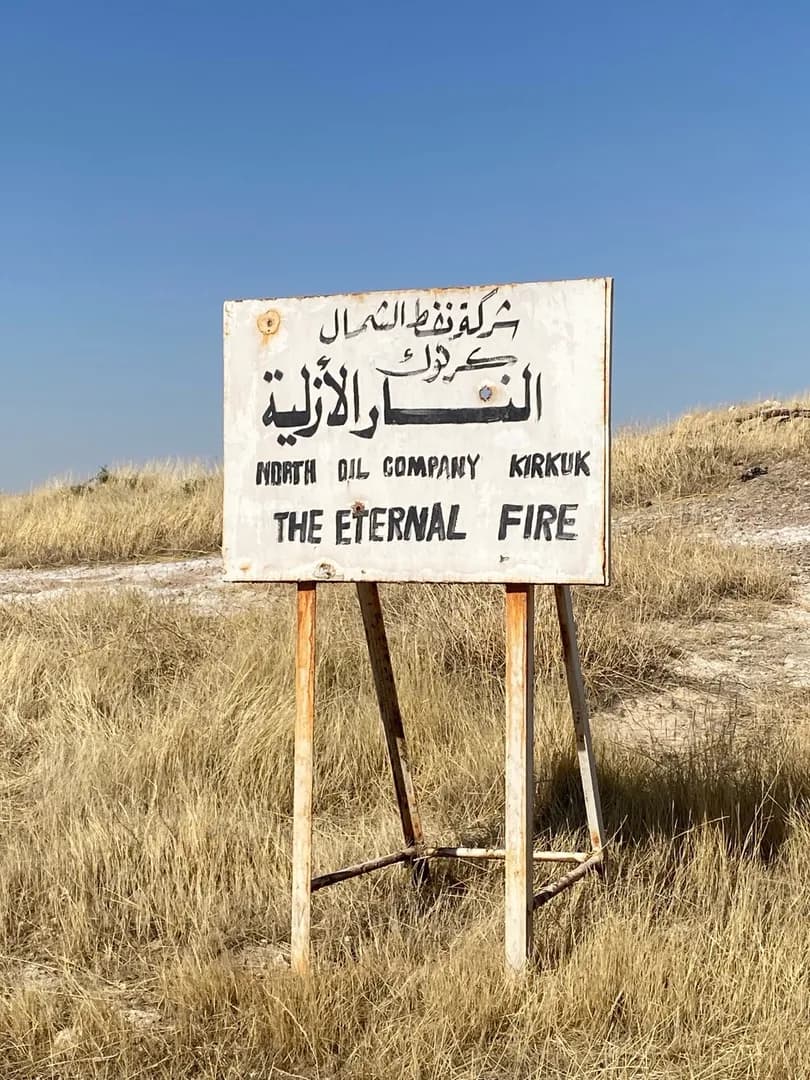
Main image: A North Oil Company sign at Baba Gurgur, the "Eternal Fire" in the Kirkuk oilfield, in July 2024. Photo: NICTON t / Wikimedia Commons, CC0.
Related Topics
EUReflect News
Site Administrator
Follow EUReflect
See more of our reporting on Google
Mark EUReflect as a preferred source and our stories are ranked higher for you in Top Stories, Discover and Google News — and carry a “preferred” badge when they are cited in AI results.
Add EUReflect as a preferred source