Europe’s New Era in Child Rehabilitation
EU4Health-funded projects are developing devices for home rehab, including a modular system for upper-limb exercises and dynamic head support for severe neuromotor impairments.
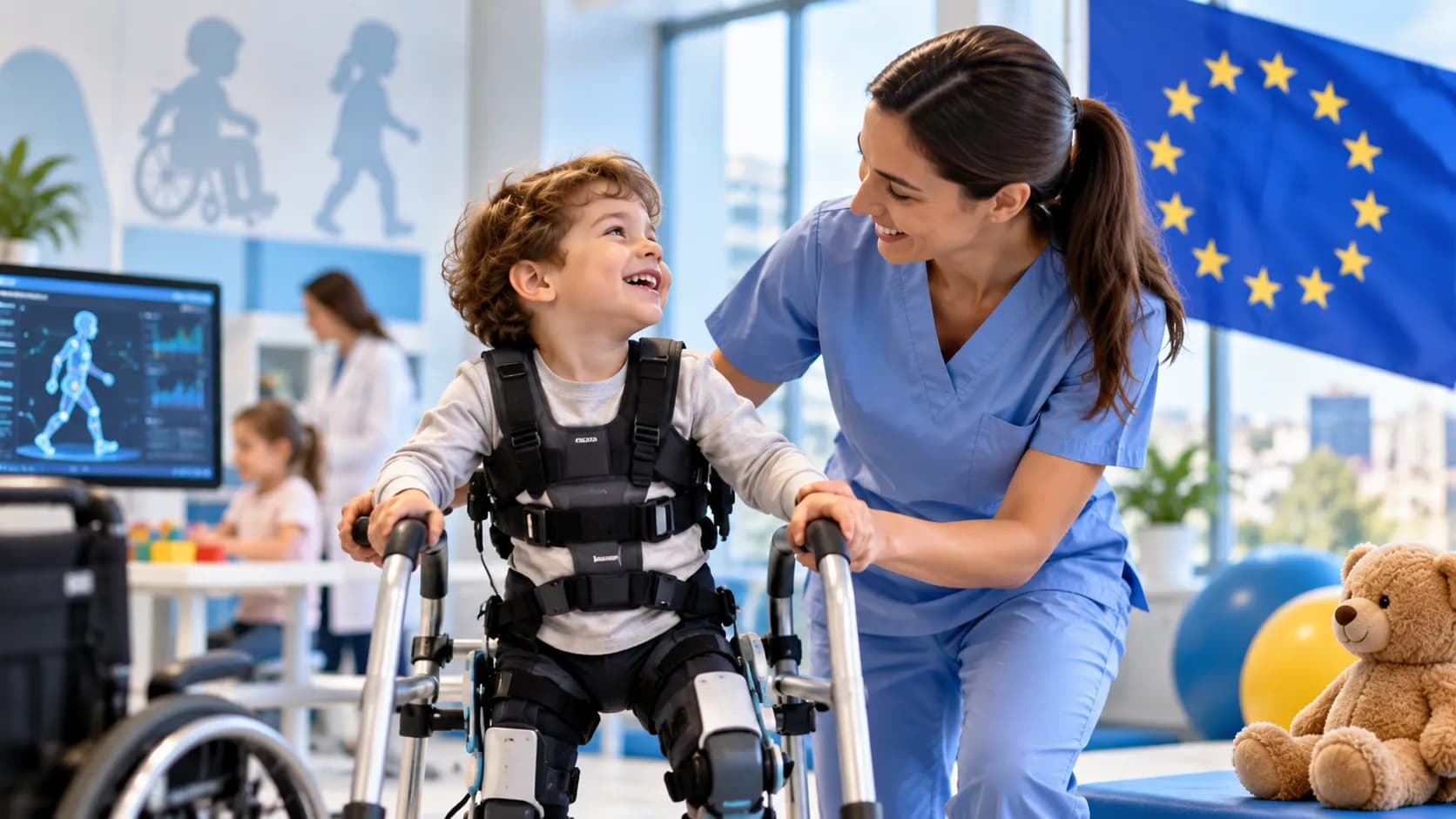
Europe is entering a new phase in its approach to children with disabilities, with rehabilitation increasingly linked to early intervention, assistive technologies, family support and community-based services rather than long-term institutional care.
Recent initiatives from the European Union point toward a model in which rehabilitation is not considered simply a medical treatment delivered in hospitals or specialised centres. Instead, health services, education, social protection, digital technologies and family participation are increasingly being brought together around the individual needs of the child.
EU Backs New Rehabilitation Technologies for Children
One of the clearest developments in 2026 has come through the EU4Health programme.
The European Health and Digital Executive Agency (HaDEA) announced that EU-supported projects are helping develop specialised medical devices for children with rare diseases and complex conditions.
Among the technologies currently receiving support are a modular rehabilitation system for children's upper-limb motor and cognitive exercises, dynamic head-support technology for children with severe neuromotor impairments and devices designed to improve gait and mobility among children with rare neurological conditions.
Another EU-supported initiative has developed a prototype aimed at enabling home rehabilitation for children with spinal muscular atrophy Types 2 and 3.
These projects demonstrate an important change in European rehabilitation policy: treatment is gradually moving beyond the walls of traditional rehabilitation facilities and becoming increasingly connected to children's everyday environments.
Read more from the European Health and Digital Executive Agency
From Institutions to Community-Based Support
Technology, however, represents only one dimension of Europe's changing approach.
In May 2026, the European Commission presented new measures under its disability policy framework. According to the Commission, around 90 million Europeans live with disabilities, while approximately 1.4 million people with disabilities still live in institutional settings.
One of the significant initiatives announced by the Commission is an Alliance for Independent Living, intended to support the transition away from institutional models toward community-based services.
The Commission is also placing greater emphasis on assistive technologies, including artificial intelligence-based tools.
For children with disabilities, this direction is particularly important. UNICEF reports that children with disabilities in Europe and Central Asia are significantly more likely to be placed in residential care than children without disabilities. UNICEF's long-term objective for the region is to move toward zero children living in institutional care by 2030.
European Commission – Disability and Inclusion
UNICEF – Child Protection in Europe and Central Asia
Early Intervention Can Change a Child's Future
Evidence from European countries also demonstrates why early and continuous rehabilitation matters.
A UNICEF case documented in Bulgaria describes the experience of a six-year-old child with cerebral palsy who received examinations, rehabilitation and multidisciplinary support through a mobile community team. After substantial developmental difficulties during early childhood, sustained intervention contributed to major improvements in mobility and communication.
Such examples reinforce a principle increasingly recognised across rehabilitation systems: intervention should begin as early as possible and continue across the environments in which the child actually lives.
This means connecting physiotherapy and occupational therapy with speech and language support, psychological services, special education, family training and social participation.
UNICEF – Timely Support Transforms Childhood
The European Child Guarantee Gains New Importance
The EU is simultaneously strengthening the social framework surrounding vulnerable children.
In 2026, the European Child Guarantee was reinforced as part of the European Commission's wider anti-poverty agenda. Around 19.3 million children in the EU are currently at risk of poverty or social exclusion.
The initiative seeks to guarantee vulnerable children effective access to essential services including healthcare, early childhood education and care, education, healthy nutrition and adequate housing.
Children with disabilities remain particularly important within this framework because medical rehabilitation alone cannot guarantee inclusion. A child may receive excellent clinical treatment but still face barriers in education, transportation, social participation or access to appropriate assistive technologies.
European Commission – European Child Guarantee
A New Generation of Child Rehabilitation
Taken together, Europe's recent initiatives suggest that the future of child rehabilitation will increasingly be built around several interconnected principles: early intervention, personalised rehabilitation programmes, family participation, multidisciplinary professional teams, home and community-based services, assistive technologies and digital monitoring.
Artificial intelligence and digital health technologies could further accelerate this transformation by allowing professionals to monitor children's progress over longer periods and adapt rehabilitation programmes according to individual development.
The larger policy shift is equally significant.
Europe is gradually moving from a system centred primarily on treating disability toward one focused on enabling children to participate fully in family, education and community life.
For countries developing or reforming their own child rehabilitation systems, the European experience therefore offers an important lesson: successful rehabilitation does not end when a therapy session finishes.
It requires a continuous ecosystem connecting the child, family, specialists, healthcare institutions, schools, social services and digital technologies.
That integrated approach may ultimately define the next generation of child rehabilitation.
Zhansaya Nurlanovna
Contributing writer at EUReflect.
Follow EUReflect
See more of our reporting on Google
Mark EUReflect as a preferred source and our stories are ranked higher for you in Top Stories, Discover and Google News — and carry a “preferred” badge when they are cited in AI results.
Add EUReflect as a preferred source